

Guide
The 90‑day planning guide
By Corinne Hale. A practical way to connect a three-year direction to the work your leadership team actually finishes each quarter.
- Write a direction and one-page plan
- Choose priorities with owners and dates
- Run the review and handle unfinished work
Start with the direction
A quarterly plan is useful only when it points somewhere. Before choosing work for the next 90 days, the leadership team needs a shared picture of the company it is trying to build. Otherwise, the most recent problem can become the plan.
Throughline uses a planning rhythm with five parts. First, set a one-page plan once a year, with the three-year direction, three to five annual goals and numbers that show progress. Second, choose three to five 90-day priorities for the company. Third, review a weekly scorecard with five to fifteen numbers. Fourth, hold a weekly leadership meeting to review the scorecard, priorities, issues and actions. Fifth, complete a quarterly review of what was finished, what was not and why, then choose the next priorities.
Start with the three-year direction. It gives the leadership team something to refer to when deciding what deserves attention this quarter. The direction should be clear enough that leaders can repeat it without consulting a document.
Picture an invented commercial bakery. The business owner oversees production and customer relationships. Two managers handle daily operations, but questions about scheduling and customer commitments still come back to the business owner. The bakery serves several kinds of commercial customers, and its managers have different views of which work deserves attention first.
A three-year direction gives that team a common reference for its decisions. The business owner and managers decide what belongs in it. The coach does not choose the company’s direction or supply its targets.
Put the year on one page
The one-page plan connects the longer direction to the current year’s work. Set it once a year. It holds the three-year direction, three to five goals for the year and the numbers that will show progress. Keep those elements together so the team can refer to the same plan during ordinary management conversations.
Begin with the direction the team has agreed. Then identify three to five goals for the current year. A goal should make sense in the context of where the company intends to go, rather than appearing because one person raised it at the last meeting.
For the commercial bakery, the business owner and managers might discuss how production schedules are managed, how customer commitments are handled and which numbers they need to examine together. They would choose their own annual goals and decide which deserve a place on the plan.
Next, identify the numbers that show progress. Throughline’s weekly scorecard examples include on-time deliveries, cash collected, overtime hours and open positions. These are examples of measures a company might already track, not required measures for every business.
The bakery might choose on-time deliveries and overtime hours because both relate to work its managers already discuss. The leadership team would decide the appropriate targets and assign one person to each number.
The completed one-page plan contains three things:
- The company’s three-year direction.
- Three to five goals for the current year.
- Numbers that show progress toward those goals.
Those elements remain available when the team chooses its quarterly priorities. The page is a record of the company’s decisions, not a plan written by the coach.
Choose the next 90-day priorities
A yearly goal is too large to carry into Tuesday’s work unchanged. A 90-day priority describes one finished result, one person responsible and a completion date inside the quarter. At the end, the team should be able to answer whether it was done or not done.
Choose three to five 90-day priorities per company and one to three per person. That keeps the quarterly commitments visible alongside the work everyone already has to manage.
Start with the annual plan and the work the leadership team believes deserves attention in the coming quarter. The team decides which results matter enough to become commitments. Each priority needs wording that describes something finished, rather than a general intention.
Write the finish line
Return to the commercial bakery. Suppose the managers regularly bring production scheduling questions to the business owner because the responsibilities for approving schedule changes are unclear.
A quarterly priority might read: written responsibilities for approving production schedule changes are agreed by the business owner and two managers, with the production manager responsible for completing the document by a named date this quarter.
That describes a finished result. The production manager is the person who owns the priority. The team still decides what those responsibilities should be and which decisions the managers can make.
Compare that wording with a priority such as improve scheduling. The second statement offers no clear way to decide whether the work is finished. People could spend the quarter discussing scheduling without agreeing on what completion means.
Check each proposed priority against the definition:
- One finished result that can be marked done or not done.
- One named person responsible for that result.
- One completion date within the quarter.
- Three to five priorities for the company.
- One to three priorities assigned to each person.
When a priority involves several people, one person still owns its completion. The others may contribute, but the commitment should not belong to an unnamed group.
Keep the plan in the working week
The weekly scorecard and leadership meeting connect quarterly priorities with ordinary management work. They give the team a regular place to examine the numbers, check commitments and discuss issues before the next quarterly review.
Read the weekly scorecard
The scorecard holds five to fifteen numbers, each with a target and one person responsible. Keep it in a shared spreadsheet the company owns. The leadership team reads it every week.
For the commercial bakery, the team might track on-time deliveries, overtime hours and cash collected. These are possible measures, not prescribed targets. The business owner and managers choose which numbers belong on their scorecard and who will update them.
When a number is off target for two weeks, put it on the issues list. The number identifies something for the team to discuss. It does not explain the cause by itself.
For example, the bakery’s on-time delivery number might be below its chosen target. The team would put that issue on the list and discuss it during the leadership meeting. The scorecard does not decide what action the team should take.
Hold the weekly leadership meeting
Meet on the same day and at the same time each week. Allow 60 to 90 minutes. Use the same agenda:
- Spend five minutes reviewing the scorecard.
- Spend five minutes checking whether 90-day priorities are on track or off track.
- Use most of the meeting to work through the ranked issues list.
- Use the final five minutes to assign actions with one owner and a date.
An issue may concern a scorecard number, a quarterly priority or another matter requiring a leadership decision. The team ranks the issues and works through them during the meeting.
Every action leaves with one person’s name and one date. Writing that the team will discuss production scheduling again does not identify who owns the next action. Naming the production manager and recording a date makes the commitment clear.
The weekly meeting also gives the person responsible for each quarterly priority a place to report whether the work remains on track. The written finish line stays the reference point.
Coaching sessions are where the business owner prepares for and follows through on this rhythm, while the leadership team makes the decisions and does the work.
Use a day to review the quarter
The Quarterly Planning Day is the quarterly review at the end of the planning rhythm. It closes the previous 90 days and sets the next priorities. Throughline’s facilitated day runs from 8:30 AM to 4:00 PM, with the people who will carry the priorities, usually four to ten participants.
The leadership team brings its decisions, previous commitments and numbers into the room. The facilitator organizes the conversation and records what the team decides.
Prepare the material
About two weeks before a facilitated day, the team’s leader has a 30-minute planning call. One week before the day, the team sends the previous quarter’s priorities and weekly scorecard to the facilitator.
These documents provide the starting point for reviewing the quarter. They show what the team committed to and which numbers it has been following. The planning day is not a replacement for the weekly meetings that took place during the quarter.
Work through the agenda
- Review the quarter, 90 minutes. Check the previous quarter’s priorities against their written finish lines. Identify what was completed and what was not.
- Look at the numbers, 60 minutes. Review the scorecard and discuss what the figures show.
- Work the issues, 120 minutes. Rank the issues and work through them, keeping the conversation focused on decisions.
- Set priorities, 90 minutes. Choose three to five results for the next quarter, each with one named owner and a completion date.
- Make commitments, 30 minutes. Agree on the commitments and what will be communicated to the wider team.
The facilitator designs the agenda, keeps attention on decisions, makes room for each person’s contribution and writes down what the team agrees. The leadership team supplies the numbers, decides what matters and owns the resulting plan.
For the commercial bakery, the team would bring its scorecard and the written scheduling priority. It would review whether that priority met its original finish line, consider the issues still open and decide which results deserve attention next quarter. The example does not assume that any particular decision or result follows.
Within five business days after a facilitated planning day, Throughline sends a written summary of the decisions, next quarter’s priorities and their owners. The summary records the team’s decisions. It is not a consultant’s strategic plan, a market study or a financial forecast.
Decide what a missed priority means
At the quarterly review, some priorities may be unfinished. Use their original wording to determine what was completed and what remains open. Then examine the missed commitment before deciding whether it belongs in the next quarter.
Throughline uses three questions, asked in order:
- Was it still the right priority?
- Was it one person’s to own?
- What took its place?
The first question asks whether the commitment still belongs among the company’s priorities. The second checks whether responsibility was clear. The third asks the team to identify what happened during the quarter instead of leaving the missed date unexplained.
Suppose the commercial bakery’s written scheduling responsibilities were drafted but never agreed. The production manager may have prepared the document while the business owner still had questions about which approvals should move to the managers. The team would review the unfinished priority using the three questions rather than mark it complete because a draft exists.
After that discussion, the team has two choices. Carry the priority into the next quarter with a new first step, or drop it deliberately and say so. A priority does not need to remain on the list simply because it appeared there previously.
For the bakery, carrying the priority forward might mean identifying a review of the draft as the new first step. Dropping it would mean explicitly deciding that the original commitment no longer belongs in the next quarter. Neither choice is automatic.
The quarterly review records what the team decides. The next set of priorities should reflect those decisions, with clear responsibility and dates for the work being carried forward.
A first 90 days
The following is a typical sequence for a business owner beginning to get out of the middle of daily decisions. It is not a promised timetable or a separate planning method. It follows Throughline’s first 90 days of getting out of the middle, with the weekly scorecard introduced before the weekly leadership meeting.
Month one: examine the owner’s work
Start with the business owner’s calendar for the last two weeks. Mark time spent on direction, people, cash and culture, work someone else could do, and interruptions. Then list everything the business owner did during two ordinary weeks.
From that list, identify the work only the business owner can do and choose the first three things to hand off from the remaining work. The starting point is what actually occupied the business owner’s time, not what the job description says should happen.
At the invented commercial bakery, the business owner might find recurring production schedule questions and routine customer coordination among the work being handled personally. Those are examples to examine, not decisions about what must be delegated. The business owner chooses the first three items.
Month two: hand off and start the scorecard
Hand over the chosen work using the one-page briefing. It records the result wanted, why it matters, limits, the level of authority, the first check-in date and the deadline.
Use a stated level of authority for each handoff. The level tells the person whether to report back, recommend a decision, obtain approval before acting, report after acting or decide without reporting. The business owner and the person taking the work know what authority has been assigned.
Start the weekly scorecard this month. Choose five to fifteen numbers, each with a target and one owner, and keep them in a shared spreadsheet.
For the bakery, the leadership team might consider on-time deliveries, cash collected and overtime hours. The team chooses the measures and targets. Nothing about the example assumes that the numbers change during the month.
Month three: establish the meeting
Start the weekly leadership meeting using the regular agenda: scorecard, quarterly priorities, ranked issues and actions. Hold it on the same day and at the same time each week, with one person and one date assigned to each action.
Review the authority given to people who have taken on work. Raise a level where it has been earned. The business owner still makes the decisions about what authority to assign.
For the bakery, the production manager might bring a scheduling question to the meeting, while another manager reports on a number from the scorecard. The team discusses the issue and records any action it chooses. No particular resolution is assumed.
During this last month, set the next quarter’s three to five 90-day priorities. Each needs a finished result, one named owner and a date inside the quarter. Review unfinished priorities using the three missed-priority questions and decide whether to carry them forward with a new first step or drop them on purpose.
At the end of this typical sequence, the records to examine are the handoffs, scorecard, meeting commitments and next quarter’s priorities. They show what the business owner and leadership team have agreed to manage and review. The decisions and the work remain theirs.
Free planning resource
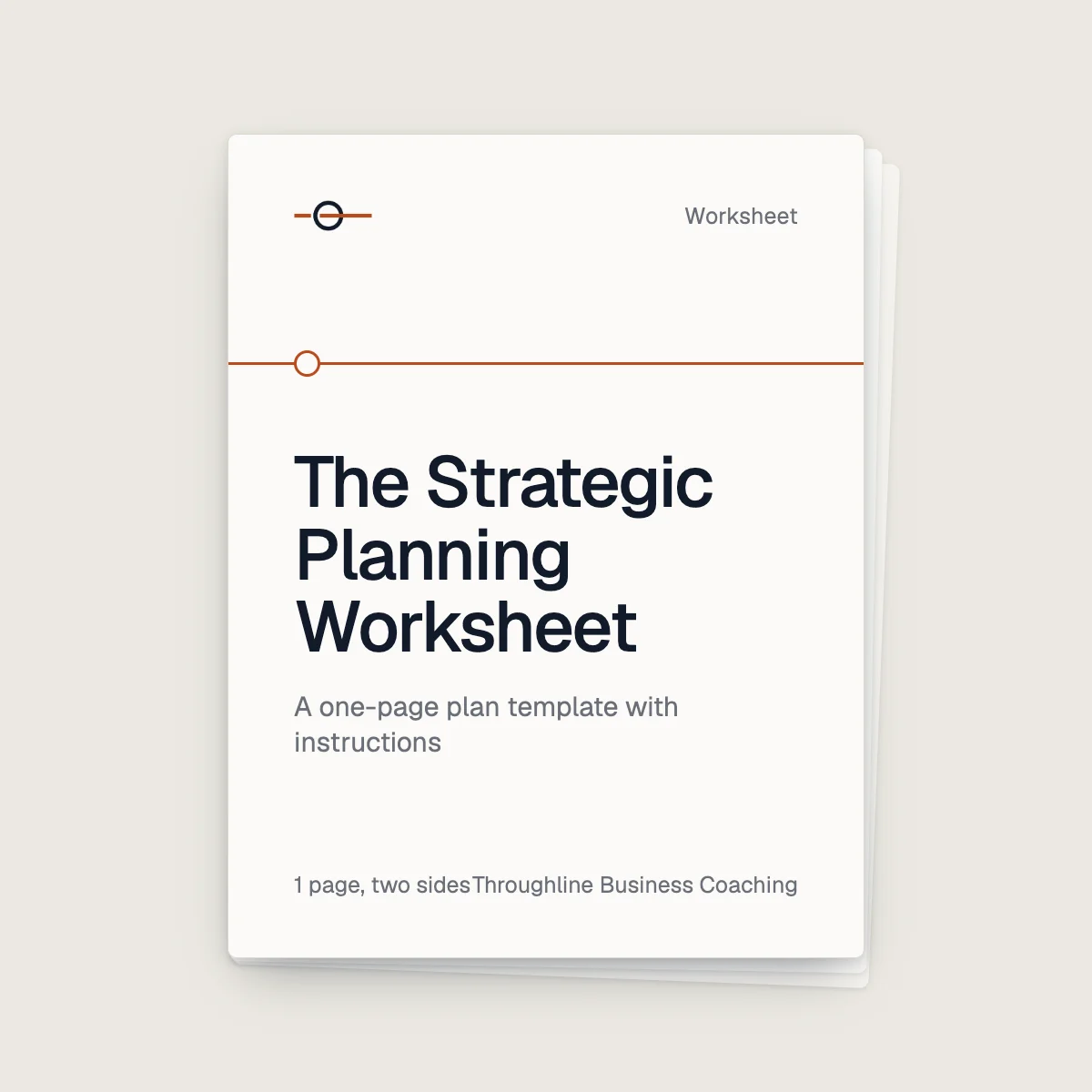
The Strategic Planning Worksheet
The Strategic Planning Worksheet gives you a one-page plan template, with instructions on the back.
- Space for your three-year direction
- Room for this year’s three to five goals
- A place to name progress numbers
"*" indicates required fields
Your email is used to send the worksheet. You receive the newsletter only if you tick its box. Unsubscribe in any email. This is a demo. What you enter goes to Vegas Website Designs, and we only use it to reply to you.
More on the planning rhythm
A conversation about coaching
Talk with a Throughline coach about your business, your role and what you are looking for. Together, you can decide whether coaching is a fit.