

Guide
The owner's guide to getting out of the middle
A business can have capable people and still depend on its owner for nearly every decision. Corinne Hale explains how to recognize the pattern and begin changing it.
- Ten signs that decisions depend on the owner
- A calendar test and four essential owner jobs
- Delegation rules and a first 90-day sequence
Ten signs that decisions wait for you
Owner dependence often starts with a reasonable response to a small problem. A customer asks for an answer and the owner knows it. A manager needs approval and the owner gives it. Nobody intends to build a business around one person’s availability. Yet the same questions keep returning, and decisions wait when that person is occupied.
Imagine a local sign shop. Its owner reviews every production schedule change, answers routine customer questions about order status and resolves disagreements about which job comes next. The production lead knows the work but still asks before shifting the order of jobs. This is an invented example, not a client account.
Look for these ten signs in your own business:
- Only the owner can price a job or prepare an estimate.
- Important customers will speak only to the owner.
- Approvals sit on the owner’s desk waiting for a decision.
- The owner cannot take a week away without the phone.
- Essential knowledge lives in the owner’s head, not in written instructions.
- Every purchase requires the owner’s signature.
- Managers bring problems instead of recommendations.
- Every hiring decision goes through the owner.
- The schedule must be rebuilt when the owner is absent.
- The owner’s calendar has no planning time.
The list is not a score or a diagnosis. It shows where information, decisions and responsibility are concentrated. A business may show several signs for the same underlying reason. At the sign shop, questions about order status and production sequence could both reflect unclear authority. Ask what cannot move until the owner responds.
Read the last two weeks of your calendar
Print the last two ordinary weeks of your calendar. Include appointments and the work that occurred between them. If customer calls interrupted production planning or you handled scheduling questions after a meeting, account for that time.
Mark each block in one of three groups:
- The four owner jobs: Direction, people, cash and culture, the work only the owner can do.
- Work someone else could do: Tasks that could move with the right explanation and authority.
- Interruptions: Questions, approvals or problems that break into other work.
Compare the share of the working week in each group. There is no target percentage. Notice recurring interruptions and missing authority.
In the sign shop example, the owner might mark order updates as work someone else could handle, and questions about the production sequence as interruptions. A decision about the company’s direction would remain owner work.
Keep the marked calendar for the quarterly review.
Know the four jobs only you can do
The four owner jobs are direction, people, cash and culture. These are the work only the owner can do, not every task that touches those subjects.
Direction: Put the three-year direction into three or four sentences the leadership team can repeat without notes. Say what the business will be known for, about how large it will be, which customers and work it will pursue, and what it will stop doing.
People, cash and culture: These are the other three owner jobs. The names define the categories here; they do not mean that every hiring step, purchase approval or staff question must cross the owner’s desk.
For everything else, return to the two-week list and the delegation test. At the sign shop, the owner can keep direction on the calendar while examining whether routine order status replies or production sequence updates still require personal approval.
Choose a first task to hand off
List everything you did during those two ordinary weeks, including work that never appeared on the calendar. Mark the four owner jobs. From what remains, choose work that meets all three conditions: it repeats every week, has a clear right answer, and would be the least costly if someone did it imperfectly once.
Start with a modest, repeated task that makes instructions and authority easier to check. In the sign shop, routine order status replies might be a better first handoff than decisions about an unusual production conflict. The owner can identify what information a response needs and which questions should return for review.
Write a one-page briefing with exactly six lines:
- The result you want.
- Why that result matters.
- The limits, including budget, time and what must not change.
- The level of authority the person has.
- The date of the first check-in.
- The deadline.
The production lead’s briefing might describe an accurate customer order status update, its purpose and the information that must be checked. It would also state which decisions need approval, when the owner and lead will check the work, and when the task is due.
If the work comes back, examine the handoff. Was the intended result described? Did authority come with the assignment? Was a check-in set? Did the owner take the task back at the first mistake? Was the person shown what acceptable work looks like?
State the level of authority
A task can have a clear result and still stop at the owner’s desk if the person doing it cannot make the necessary decision. State the authority level when handing over the work. Throughline describes five levels:
- Level 1: Look into it and report back. I decide.
- Level 2: Bring me options with your recommendation. I decide.
- Level 3: Decide and tell me before you act.
- Level 4: Decide and act, then tell me afterwards.
- Level 5: Decide and act. No report is needed.
For the sign shop’s first order update handoff, the owner might choose a level that requires a recommendation before replying. When trust is earned, the authority level can rise.
Write down decisions that recur each week. With managers, mark each role as one that decides alone, decides after asking or recommends. Review this one-page list each quarter. A routine update may have a different decision path from changing production order.
Check actual work at the agreed date. Discuss decisions outside the limits and clarify unclear instructions. Moving authority depends on the trust developed through work and review, not on telling someone to take more initiative.
Give decisions a weekly rhythm
Delegation needs a way to track commitments without making the owner the answer to every question. The planning rhythm begins with a one-page plan, set once a year. It records the three-year direction, three to five goals for the year and the numbers showing progress.
Next, set three to five 90-day priorities for the company each quarter. Each priority has one finished result, one named owner and a date within the quarter. Write it so the answer can be done or not done. Keep each person’s list to one to three priorities. The sign shop might choose a priority about documenting who handles routine customer updates.
Use a weekly scorecard with five to fifteen numbers. Each has one owner and a target, and the figures live in a shared spreadsheet the business owns. Choose numbers that show the work, such as jobs completed on schedule or callbacks. If a number misses its target for two weeks, put it on the issues list.
Hold a leadership meeting on the same day and at the same time each week, lasting 60 to 90 minutes. Keep the agenda unchanged:
- Scorecard, five minutes.
- 90-day priorities, on track or off, five minutes.
- Issues list, ranked and worked through, most of the meeting.
- Actions, each with one owner and a date, five minutes.
Do not assign an action to “we.” Each commitment needs one person’s name and one date. When somebody misses it, use the same five steps: name the commitment and the date; ask what happened and listen; ask what will be done and by when; write the new date where both can see it; if it is missed a second time, make the conversation about the pattern, not the task.
At the quarterly review, look at what was finished and what was not. For a missed priority, ask in order: was it still the right priority; was it one person’s to own; what took its place? Carry it into the next quarter with a new first step, or drop it on purpose and say so. Owners and managers decide and do the work.
A first 90 days
The first quarter provides a sequence for examining and changing decisions. It is not a deadline for removing the owner from daily operations. No particular handoff is promised.
Month one: identify what waits on you
- Print two ordinary weeks of calendar entries and mark owner jobs, transferable work and interruptions.
- List what you did in those weeks and identify the four owner jobs: direction, people, cash and culture.
- Choose the first recurring, clear, low-cost task to hand off.
- Write its six-line briefing, state an authority level and set the first check-in.
- Using the annual one-page plan, set the first three to five 90-day priorities, each with one named owner, a finished result and a date.
In the sign shop, the owner might select routine order updates for the first handoff and write the limits before discussing the task with the production lead.
Month two: practice and measure
- Let the assigned person work within the agreed authority level and meet for the scheduled check-ins.
- Review examples of the work and clarify unclear instructions rather than automatically taking it back.
- Start a weekly scorecard with five to fifteen numbers, each assigned an owner and target.
- Begin the same-agenda weekly leadership meeting to review the numbers, priorities, issues and actions.
For the sign shop, the owner and production lead could review whether order updates follow the briefing and where approval is still needed.
Month three: review what happened
- Review which quarterly priorities were finished and which were not.
- For each missed priority, ask whether it was still right, whether one person owned it and what took its place.
- Carry a missed priority forward with a new first step or drop it deliberately and say so.
- Set the next three to five 90-day priorities with named owners, and consider a higher authority level where trust has been earned.
- Mark a recent calendar against the original two-week record and compare how time is used.
At the sign shop, the questions remain specific: Are order updates still waiting for the owner? Does the production lead have the information and authority stated in the briefing? Which interruptions still appear in the calendar?
Owner dependence is easier to discuss when it is visible as tasks, decisions and dates. Keep the records and choose what to change next. Coaching supports the owner’s decisions and follow-through.
Free owner resource
Ten signs, with a step for each
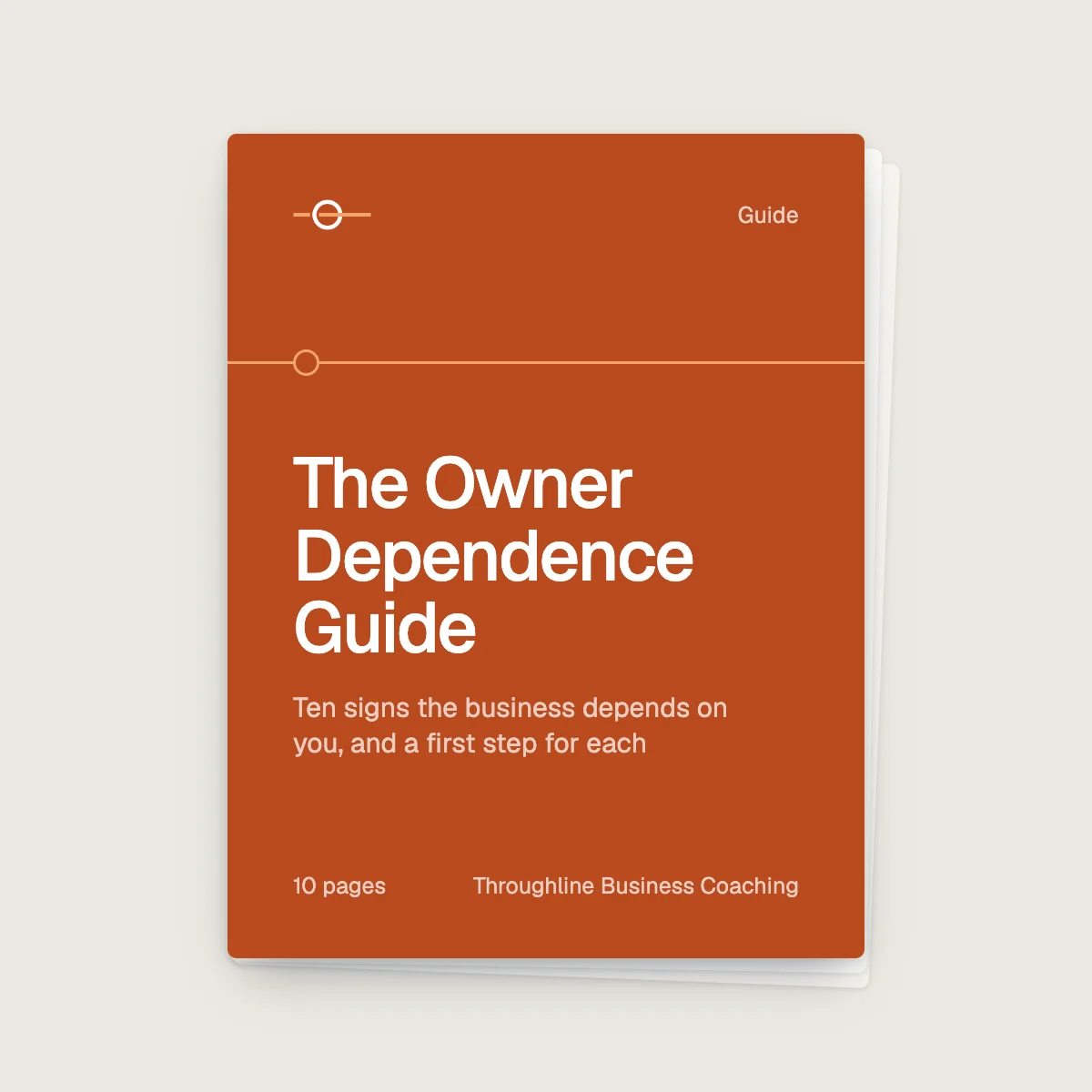
The Owner Dependence Guide is a 10-page PDF for identifying where decisions and responsibilities collect around the owner.
- Ten recognizable signs of owner dependence
- A practical first step for each sign
- A reference to use when reviewing your own role
"*" indicates required fields
Your email address is used to send the guide. The newsletter is sent only if you tick the box. Unsubscribe in any email. This is a demo. What you enter goes to Vegas Website Designs, and we only use it to reply to you.
Read more about the owner's role
The decisions worth discussing
When decisions keep landing on your desk, a free 30-minute consultation offers a chance to talk about whether coaching fits your situation.