

Guide
The weekly leadership rhythm
A useful week starts with numbers, decisions and clear owners. This guide shows how to keep the same simple habits from meeting to meeting.
- Build a weekly scorecard the team owns
- Use one agenda and one owner per action
- Handle misses and protect one-on-ones
Start with the work that matters
A leadership team can spend a full week talking and still leave the same decisions on the owner’s desk. A weekly rhythm brings the plan, the numbers and the decisions into one regular conversation.
Begin with the company’s one-page plan, set once a year. It describes where the business is going in three years, three to five goals for this year, and the numbers that will show progress. Each quarter, choose three to five 90-day priorities, each with one named owner. Write each as a finished result with a date inside the quarter.
Picture a print shop with an owner, a production manager, a customer service manager and a shift supervisor. Orders are waiting for production dates, some deliveries are late, and the owner is being asked to settle scheduling conflicts. This print shop is invented. We will follow its meetings and working records through the guide.
The weekly rhythm connects quarterly priorities to the work in front of the team. A shared spreadsheet, an issues list and an action list are enough to begin. Leaders supply accurate information, make the decisions and do the work.
Build a scorecard people can read
A weekly scorecard contains five to fifteen numbers. Each has a target and one owner. Keep it in a shared spreadsheet owned by the company, where the leadership team can update and read it. Choose measures that describe work the people in the room can influence.
For the print shop, the first draft might track on-time deliveries, jobs completed on schedule, cash collected, overtime hours and open positions. The production manager could own jobs completed on schedule, while the shift supervisor owns overtime hours. The team assigns the remaining measures to specific people, not to departments.
Give each number a clear rule
- Write the measure’s name and agree on what counts.
- Set a weekly target the team can compare with the result.
- Name one person responsible for updating it before the meeting.
- Display the latest result beside its target.
- Put a measure that misses its target for two weeks on the issues list.
Suppose on-time deliveries fall below target. The person responsible records the result without turning the scorecard review into a debate about causes. If the measure is off target again the following week, the team brings the issue into the part of the meeting set aside for decisions.
Give the meeting one job
Hold the weekly leadership meeting on the same day and at the same time. Allow 60 to 90 minutes. The job is to identify issues, make decisions and leave with actions. The agenda stays in a fixed order.
Follow the same agenda
- Scorecard, 5 minutes. Compare the current numbers with targets and identify measures that need attention.
- 90-day priorities, 5 minutes. Each owner says on track or off track. Put obstacles on the issues list.
- Issues, most of the meeting. Rank the list, begin with the most important issue and work toward a decision before moving on.
- Actions, 5 minutes. Read commitments aloud, each with one owner and one date.
At the print shop, the team sees late deliveries and a production schedule that is still unsettled. It ranks the issues rather than starting with whichever manager speaks first. A useful first decision might be to assign the production manager to bring the scheduling facts for a specific set of orders.
Sometimes the team cannot decide until someone gathers more information. That is still a decision about the next action, with a person responsible and a deadline. Ask the manager closest to the work for a recommendation. Do not let every decision return to the owner simply because the owner is present. If approval belongs with the owner, identify what the manager must bring back for that approval.
Keep issues separate from the quick scorecard and priority checks. A missed number can require discussion, but the agenda provides a place for that discussion.
Put one name beside every action
A decision needs a written commitment. Every action leaving the meeting has one person’s name and a date. A department is not an owner, and two names do not make a shared commitment clearer. Avoid writing we in the owner column.
In the print shop, the production manager agrees to review orders whose delivery dates are uncertain and bring back the information needed to decide the schedule. The shift supervisor may separately agree to bring the overtime figures for the same period. Each commitment identifies what the meeting expects to see and when.
Check each action before leaving
- Describe a result someone can observe, not just an intention to look into something.
- Write exactly one name beside the commitment.
- Record the due date where everyone can see it.
- Clarify which decision that person can make.
- Bring the item back to the next meeting for a completion check.
At the next meeting, completed work comes off the action list. Unfinished work stays visible and receives a conversation. The list should not quietly change its dates after the meeting.
Handle a miss without a speech
A commitment may be missed because a supplier does not answer, a customer changes an order, or other work takes the time set aside. Start with the agreement and the facts. The conversation can be short and specific.
Use five lines, in order
- Name the commitment and its original due date.
- Ask what happened, and listen to the answer.
- Ask what will be done now and by when.
- Write the new date where both people can see it.
- If the commitment is missed a second time, discuss the pattern rather than the individual task.
Say the print shop’s production manager was due to bring a review of uncertain orders on Tuesday and arrives without it. The leader names the expected review and its due date, then asks what happened. The manager explains what interrupted the work. The leader asks what can be done now and by which date. Both can see the replacement date on the action list.
If the same commitment is missed again, the conversation changes. It is about the repeated pattern, not another review of that one task. Record what is agreed without disguising the second miss as an ordinary first delay.
Keep the conversations that matter
The weekly leadership meeting is for issues shared across the team. It does not replace a manager’s one-on-one with an individual employee. Give that conversation 30 minutes every week or every two weeks, at the same time. Move it when necessary instead of cancelling it. The person being managed needs time to raise matters that do not belong in a room full of leaders.
Use the 30 minutes deliberately
- First 10 minutes: the team member’s topics and questions.
- Next 10 minutes: priorities, numbers and work requiring attention.
- Final 10 minutes: feedback in both directions and development.
The manager keeps notes and shares them with the team member. At the print shop, the shift supervisor might use this time to explain where an approval is holding up the shift’s work. The manager can clarify the decision that needs to be made.
When feedback is needed, give it privately within a day or two. Describe the situation, including when and where it occurred. State the behavior you saw or heard, not a judgment about character. Explain its effect. Then make the request and agree on what happens next.
Some matters require different help before that conversation. If feedback involves pay, discipline, protected leave or a complaint, involve human resources or an employment lawyer first. Coaching does not replace their advice.
Choose which meetings to cancel
Look at the rest of the calendar. Cancel a meeting that has made no decision in a month. Replace a status meeting when people could read the same information. Stop a meeting with no owner or agenda. Change a meeting that invites half a room of people who are not needed.
Keep the weekly leadership meeting and the one-on-ones. Review the other invitations against those four conditions. At the print shop, a daily status conversation might repeat information already in a written production update. The people involved can decide whether that gathering still serves a purpose or whether the written update is enough.
A first 90 days
Build the rhythm in stages rather than changing every meeting and every measure at once. The first month establishes what people will bring. The second tests whether commitments are followed. The third provides a quarterly review and a decision about what belongs in the next quarter. This is a working sequence, not a promised timetable for results.
First month: make the work visible
- Review the one-page plan and confirm three to five current 90-day priorities with named owners.
- Choose weekly measures, their targets and the people responsible for reporting them.
- Schedule the leadership meeting and begin using its four-part agenda.
- Start a shared action list and a place to record issues.
The print shop may discover that people have been counting deliveries differently. Give one person responsibility for agreeing on the definition before comparing results. A first scorecard is useful only when the managers understand the figures they are bringing.
Second month: follow the commitments
- Review which actions were done and which were missed.
- Move a number that has been off target for two weeks to the issues list.
- Use the five-line conversation when a commitment is not met.
- Protect one-on-ones and remove meetings that repeat status reports.
For the print shop, the meetings can distinguish a delivery issue that needs a decision from a missing update that needs an owner. When work stalls, record what the team is waiting for and the next date.
Third month: review and reset
- Review what was finished, what was not and why.
- For every missed priority, ask in order: was it still the right priority; was it one person’s to own; what took its place.
- Either carry a missed priority into the next quarter with a new first step, or drop it on purpose and say so.
- Set the next quarter’s priorities with owners, and review which scorecard measures the team needs.
At the shop, an unfinished scheduling priority should not silently roll forward because it appeared on the last list. The managers examine whether the work still matters and whether another demand took its place. They record their decision.
A weekly rhythm is made of ordinary records and recurring conversations. The leaders bring numbers, decide what needs action and return to the agreements they made. The owner remains responsible for the owner’s decisions. Managers carry their own work. The calendar, scorecard and action list show where the responsibilities sit.
Free working resource
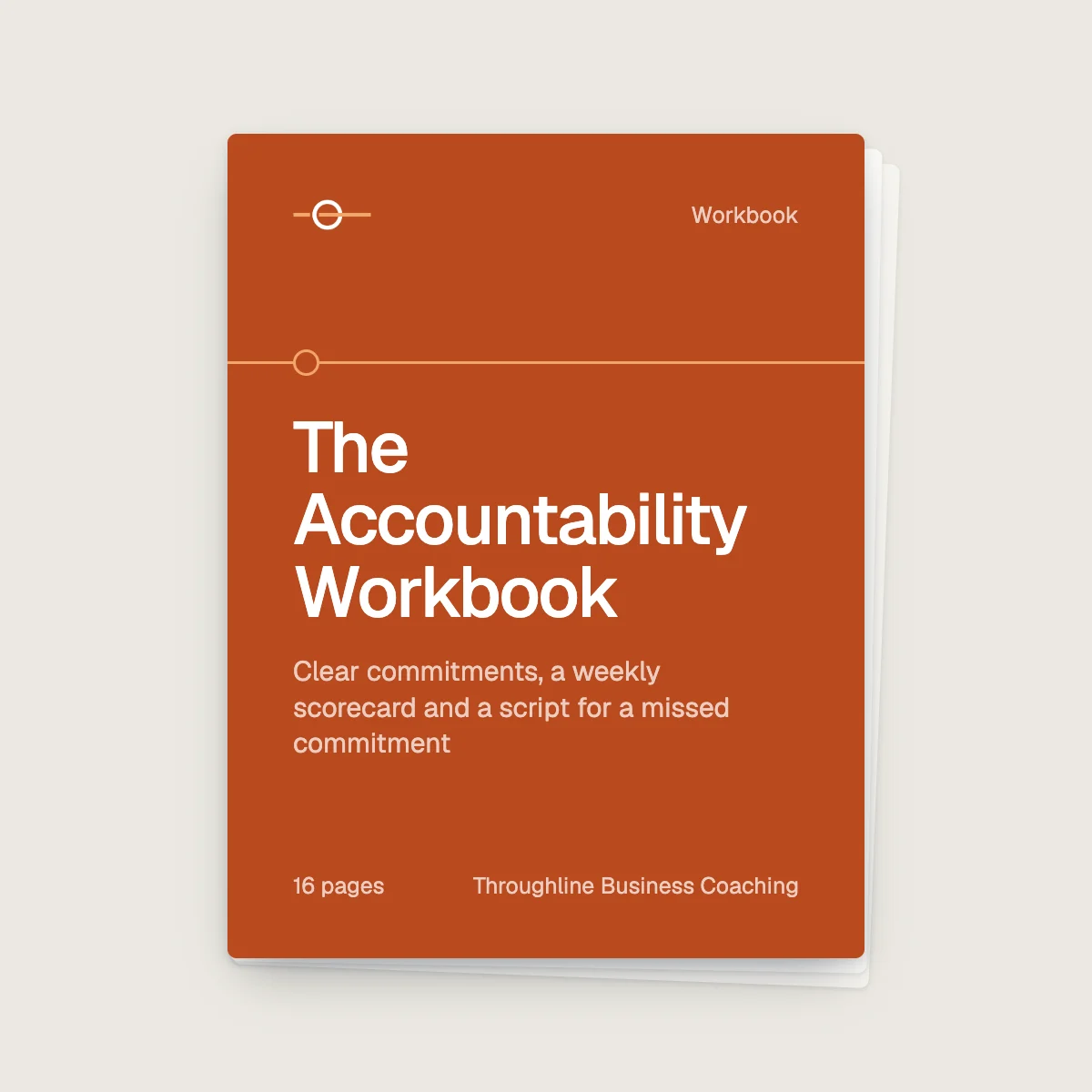
The Accountability Workbook
A 16-page resource for putting written commitments and weekly numbers into practice.
- A way to write one clear commitment
- A weekly scorecard template
- A script for a missed commitment
"*" indicates required fields
Your email is used to send the workbook. You receive the newsletter only if you tick the box. Unsubscribe in any email. This is a demo. What you enter goes to Vegas Website Designs, and we only use it to reply to you.
Read further on weekly leadership
Make room for better decisions
Talk with a Throughline coach about the meetings and commitments your team uses now. An introductory consultation costs nothing and takes 30 minutes to discuss fit.